 Spatyom

Aspects: The Meaning of the Distance Between Planets
Conjunction, square, trine, opposition... The aspects in a chart tell how planets communicate with each other. We explore what kind of relationship each aspect creates and why the idea of "bad aspects" is misleading.
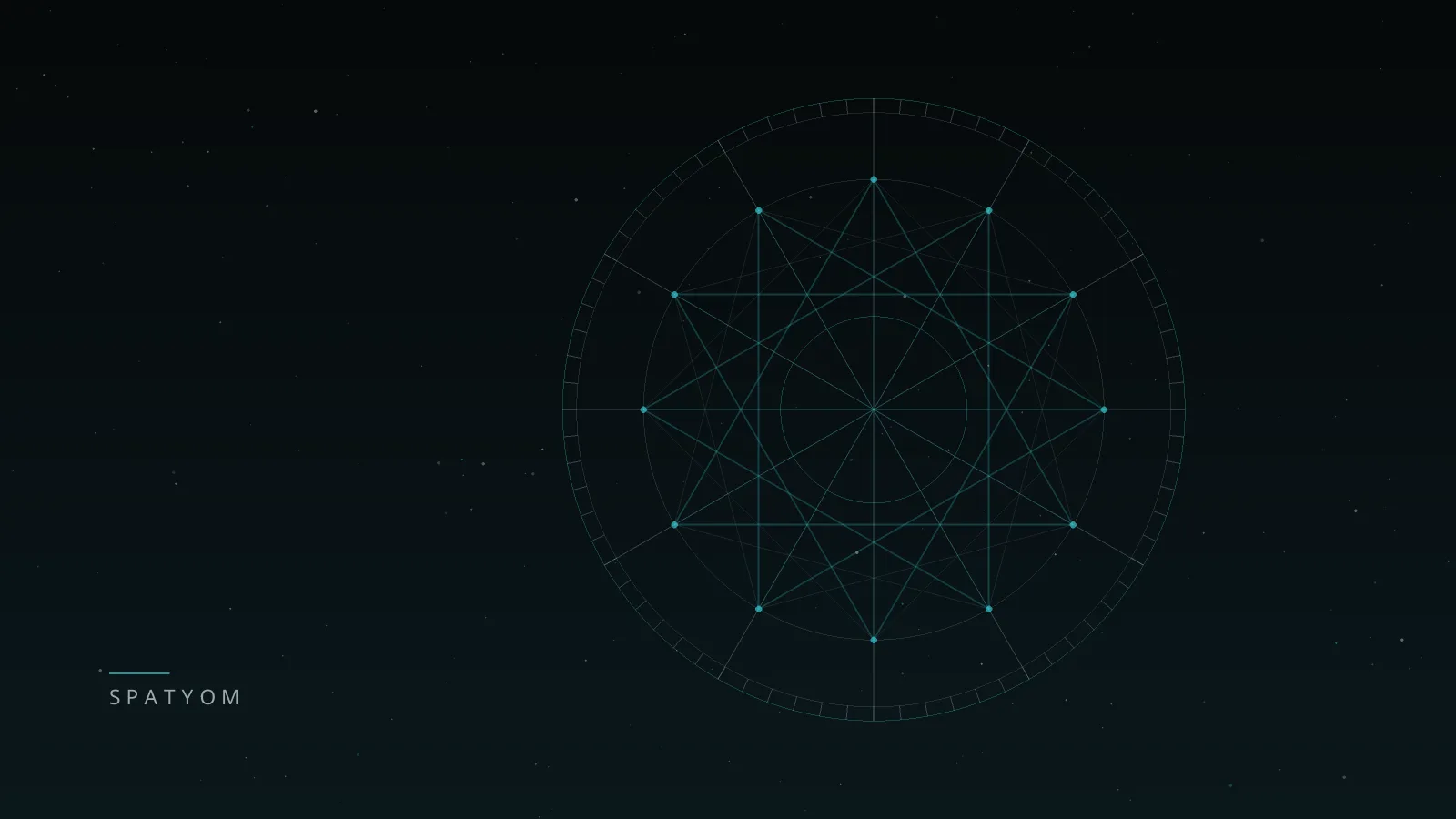
In a birth chart, not only the signs and houses of the planets hold meaning, but also the distances between them. These distances are called aspects, and they are one of astrology's most technical and most misunderstood subjects. Aspects reveal whether planets are in conversation with each other, and if so, the tone of that conversation.
What is an Aspect and How is It Measured?
The chart is a 360-degree circle. When the degree difference between two planets approaches certain values, an aspect is considered to be formed. These values are not arbitrary; they derive from simple divisions of the circle. Dividing the circle by two gives the opposition, by three the trine, and by four the square.
The measurement is not exact. Even if planets are not precisely 90 degrees apart, if they are sufficiently close, the aspect is still counted. This tolerance is called orb. The width of the orb varies from astrologer to astrologer; a general tendency is to allow a wider orb for the Sun and Moon and a narrower one for fast-moving minor planets. The closer the aspect is to exact, the more pronounced its influence is considered.
Major Aspects
- Conjunction (0°) — Two planets are at the same point. Their energies are not separate but blend together. Which planets are conjoined is decisive; this aspect is neither positive nor negative by itself.
- Opposition (180°) — Planets are at opposite ends of the circle. This creates an axis, tension, and a search for balance. It is often read as a swing between two needs of the individual.
- Square (90°) — This is the friction aspect. Two tendencies irritate each other, and this irritation produces action. It is challenging but productive.
- Trine (120°) — This is the flow aspect. Two planets support each other easily. Ease can become a talent that goes unnoticed when not worked on.
- Sextile (60°) — A gentler relative of the trine. It offers opportunity but does not function automatically; it awaits use.
Is There Such a Thing as a "Bad Aspect"?
In popular interpretation, squares and oppositions are considered "bad," and trines and sextiles "good." This distinction is misleading in practice. A square produces tension, and tension is the most common reason for development; no skill is gained without some challenge. A trine gives ease, but what is easy is often unnoticed and undeveloped.
A more accurate view is: aspects are not good or bad, but easy or difficult. Hard aspects demand awareness and effort, yielding resilience in return. Easy aspects provide a ready resource but do not automatically bring results. The strength of a chart is read not from which aspects one has, but from what one does with them.
Where Do Aspects Fit in Interpretation?
Aspects are not read in isolation. The same square takes on vastly different meanings depending on which planets are involved and which houses they occupy. A tension between the second and eighth houses tells a different story than a tension between the third and ninth, even if the aspect is the same type.
Therefore, the order of chart interpretation is important: first the signs of the planets, then their houses, and finally the aspects between them. Aspects add a layer; they do not lay the foundation. Here too, astrology does not make predictions; it reads a calculated geometry through a tradition of interpretation built upon it.
Comments
No comments yet. Be the first.