 Spatyom

Houses: Which Area of the Chart Tells Which Part of Life
Signs show how a planet behaves, while houses show where in life this will appear. We explain what the twelve houses represent and why an empty house is not a problem.
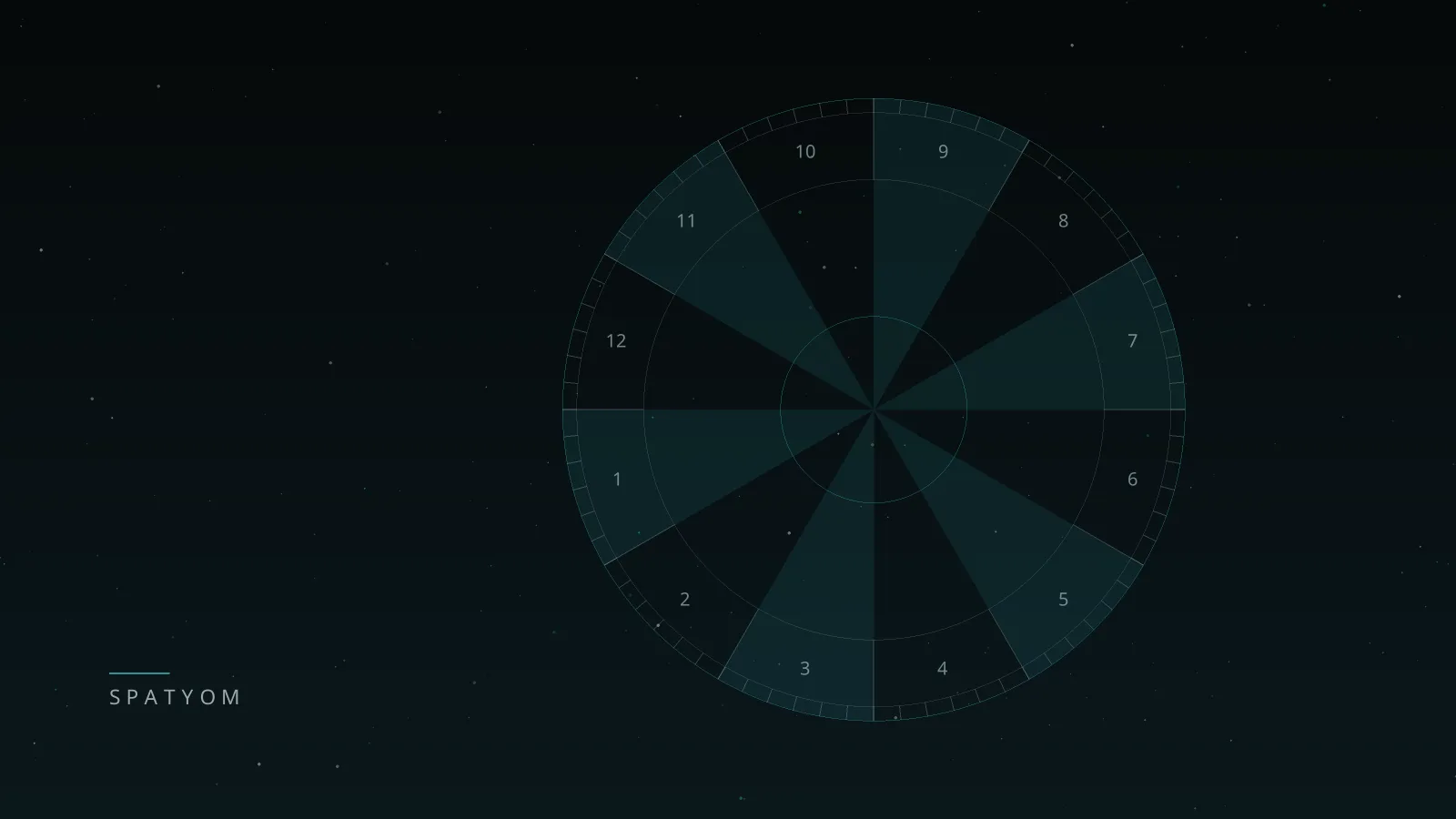
When you first look at a birth chart, you see two separate divisions. One is the signs: they divide the circle into twelve equal parts and describe how a planet behaves. The other is the houses: they divide the circle according to the horizon at the moment of birth and tell where the same planet will appear. Signs give the style, houses give the stage. Not mixing them up is the most fundamental step in chart reading.
How Are Houses Calculated?
Houses are not a division of the sky but of your place on Earth. The point rising on the horizon at your birth becomes the beginning of the first house; the circle is divided into twelve starting from there. For this reason, houses depend on the time and place of birth — two people born on the same day have their planets in the same signs, but their houses can be completely different.
There is no single way to divide. Different house systems like Placidus, Koch, and Whole Sign divide the circle using different criteria. The same chart can move a planet to a neighboring house when the system changes. This is not a mistake but a methodological preference; what matters is knowing which system you use and not changing it throughout the interpretation.
The Four Corners: The Main Axes of the Chart
Four of the twelve houses are more decisive than the others because they form the chart's axes.
- The first house is the eastern point of the horizon: appearance, first impression, how you present yourself.
- The fourth house is the bottom of the chart: roots, family, home, where you come from.
- The seventh house is the western point of the horizon: partnerships, one-on-one relationships, the other person.
- The tenth house is the top of the chart: visibility, career, public role.
These four houses are the most sensitive to the time of birth. When the time shifts, these shift first, and with them the entire architecture of the chart.
The Remaining Eight Houses
The other houses look at more specific areas of life. The second house looks at possessions and resources, the third at close environment and communication, the fifth at creativity and play, the sixth at daily routine and work. The eighth looks at shared resources and transformation, the ninth at far places and learning, the eleventh at community and goals, and the twelfth at retreat and the inner world.
These topics should not be read as rigid definitions. Houses are domains, not a list of fate. Having a planet in the sixth house does not mean "you will work hard"; it indicates that daily routine is an area where the tendency represented by that planet becomes apparent.
What Does an Empty House Mean?
This is the most frequent question from beginners, and the answer is reassuring: nothing is missing. There are ten planets and twelve houses; mathematically, at least two houses must be empty. An empty house does not mean that area of life will not be experienced.
To read an empty house, one looks at the sign on its cusp and the position of the planet that rules that sign in the chart. For example, for someone with an empty seventh house, relationships are read from where the ruler of that sign is placed. So information is not lost; it just comes from elsewhere.
The opposite is also true: having three or four planets in a house does not automatically make that area "good" or "problematic." It only shows that more emphasis falls there, that this area of life is a more intense theme for the person. Here too, astrology is not prediction but a reading of weight distribution.
Comments
No comments yet. Be the first.