 Spatyom

The Baogu Constellation: Stars of the Eight Grains
The Baogu constellation in the Ziwei region of Chinese astrology symbolizes the eight grains and the harvest cycle. Ancient texts read abundance and famine from the brightness of these stars. So which zodiac degrees do these eight stars correspond to, and how are they interpreted in today's sky?
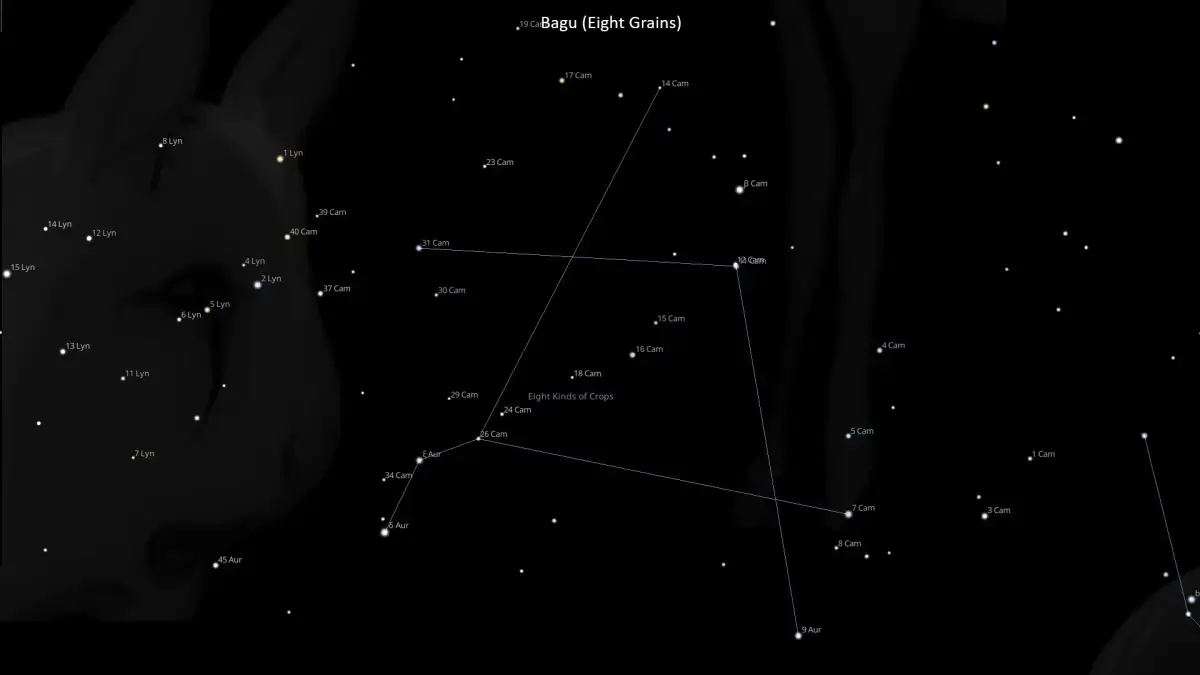
Within the rich stellar heritage of Chinese astrology, there are many constellations that carry the rhythm of agricultural life into the sky. One of them is Baogu, the "Eight Grains" constellation, the twenty-third station of the Ziwei (Purple Forbidden Enclosure) region. This pattern of eight stars lies in the border region of the Auriga and Camelopardalis constellations and was read in classical Chinese texts as a sign of harvest abundance or famine. In this article, we will examine what Baogu is, which degrees it corresponds to, the details of its traditional interpretation, and the astrological use of this symbolism today.
What Is Baogu and Where Does It Stand in the Sky?
Baogu is defined in Chinese star catalogs as an asterism formed by eight separate stars coming together. Each star corresponds to one of the grain types: rice, millet, barley, wheat, soybean, red bean, chestnut, and hemp. This list of eight shows minor differences depending on the source period; some texts count red millet and small millet separately, while others treat barley and wheat in detail. This difference also shows how agricultural classification criteria evolved over the centuries.
When matched with the zodiac degrees of Western astrology, Baogu corresponds to approximately 18°38′ to 29°56′ of Gemini. Each of the eight stars has its own degree within this range; for example, the star δ Aurigae is located at about 29°56′ Gemini, while ξ Aurigae is at about 18°38′ Gemini. These degrees occupy the final third of Gemini in the tropical zodiac. Therefore, Baogu lies in the tail portion of Gemini extending toward autumn, in a region that overlaps with the zodiac chart of Western astrology.
In Chinese astronomy, this asterism is located on the western side of the Ziwei region, north of the Five Chariots. Sources state that it stands to the right of the northern gate of the imperial palace and symbolizes the emperor's ceremonial plowing, harvest forecasting, and the management of the palace's food stores. Thus Baogu was seen not only as an agricultural indicator but also as the celestial reflection of the nutritional order of the palace and society.
The Meaning of the Eight Grains in Ancient Texts
In classical Chinese sources, the phrase "eight grains" is a two-layered concept that implies both actual crops and officials concerned with land management. Texts written during the Song Dynasty list the eight grains as millet, broomcorn millet, rice, small millet, red millet, hemp, beans, and wheat. In commentaries made during the Qing Dynasty, the list of rice, millet, barley, wheat, soybean, mung bean, red millet, and hemp comes to the fore. The main difference between these two classifications stems from counting millet and red millet separately and treating barley and wheat in detail.
In ancient times, people designated the eighth day of the first month as "Grain Day" and tried to predict the abundance or scarcity of the harvest by observing the weather on that day. This tradition gave rise to a calendar culture called "seven people, eight grains." At the Laba Festival held on that day, dried foods were offered to the god of the eight grains and prayers were made for a good harvest. This ritual shows how deeply sky observation and the agricultural calendar were intertwined.
The constellation symbolizing the eight grains was believed to be a harbinger of agricultural abundance or famine. Historical records state that when these stars appeared bright, the eight grains would ripen, and when they appeared dim, the crop would remain weak. The disappearance of a single star indicated that the harvest of the crop corresponding to that star would fail; the disappearance of all eight stars meant that the people would suffer hardship. Such readings rest on a traditional observational practice that used the sky like a warning board.
The Brightness of the Stars and the Reading of Abundance
Ancient astronomical texts directly link the visibility of the Baogu stars to social prosperity. Bright stars were interpreted as abundance, dim stars as famine. The loss of one of the eight stars meant that the grain represented by that star would not yield a crop. The invisibility of all eight stars was read as a warning of great famine. This approach reflects a system of thought that made the sky part of agricultural planning.
The texts also contain prophecies about guest stars and comets entering the Baogu region. The entry of a guest star into this region indicated that grain prices would rise rapidly, while the entry of a comet indicated that floods would come. Dark clouds or vapors covering this region were interpreted as the eight grains not yielding a crop. Such observations are concrete examples of the belief that changes in the sky directly affect life on earth.
The astrological importance of these interpretations lies in the fact that celestial events were based on an observable and repeatable calculation. Ancient observers created a kind of database by recording the positions and brightness of the stars; from this data they developed seasonal expectations. Astrology here appears as a tradition built on observation and calculation, not on prediction.
The Place of Baogu in Western Astrology
In Western astrology, Baogu can be treated as a fixed star region corresponding to the final degrees of Gemini. The range of Gemini between 18° and 29° is associated with themes of communication, learning, trade, and local mobility. A planet or lunar node placed in this region can create an emphasis on agricultural cycles, production, sharing, and the distribution of social resources. However, this interpretation, unlike the prophetic language of ancient Chinese texts, should be made with the symbolic and thematic approach of modern astrology.
The symbolism of Baogu can be associated in today's astrological readings not directly with a "harvest forecast" but rather with themes of productivity, labor, and reaping the reward. A parallel can be drawn between the versatility of Gemini and the diversity of the eight grains: managing different pieces of knowledge and skills together, just as different crops are grown together. This is a contemporary interpretation of an agricultural metaphor; no such expression appears verbatim in ancient texts.
Such fixed star regions, when they fall on a planet or angle point in a birth chart, add an extra color to the theme of that point. In the case of Baogu specifically, this color concerns the soil, labor, and produce. Still, it must be remembered that astrological interpretation is a symbolic reading, not a personal decree of fate.
Its Connection with the Celestial Calendar
The position of Baogu in Gemini gains meaning through certain transits during the year. For example, when the Sun enters Libra on September 23, 2026, the Gemini region is no longer directly illuminated by the Sun; during this period the Baogu theme remains more in the background. However, on November 24, 2026, the Full Moon in Gemini brings this region to the fore again. This Full Moon may bring up themes of production and sharing alongside communication and learning.
When Uranus stations retrograde in Gemini on September 10, 2026, it begins a period that also affects the fixed star regions in the final degrees of this sign. The movement of Uranus in Gemini points to unexpected developments in the areas of innovation, technology, and communication. Combined with the agricultural symbolism of Baogu, it can be interpreted as a period in which innovative approaches in food production, distribution, and resource management may come to the fore. Of course, this is not a definitive prediction but a thematic-level reading of celestial movements.
In conclusion, Baogu is part of an ancient tradition that read the sky like an agricultural calendar. Each of the eight stars symbolizes a grain, each grain a labor, and each labor a reward. Today we can treat this symbolism as a fixed star region located in the final degrees of Gemini; we can use it as a framework for reflecting on the cycle of production, sharing, and social resources. Here too, astrology appears as a tradition of interpretation based not on prediction but on the calculable order of the sky.
Comments
No comments yet. Be the first.