 Spatyom

Could the Taurid Meteors Cause an Airburst in 2026?
The Taurid meteor shower is known for bright fireballs lighting up the sky each October–November. But a new hypothesis suggests that in 2026 this stream might contain large near-Earth objects and could cause an airburst. In this article, we examine the astrological and astronomical background of this speculative scenario, the assumptions it relies on, and its relationship with planetary transits.
Every year from late October to mid-November, bright meteors streak across the sky. The Taurid meteor shower, also popularly called "Halloween fireballs," is formed by the burning of particles of various sizes entering our atmosphere during this period. However, a study published in 2025 suggested that this stream might contain larger-than-usual objects and that Earth could come close to these objects in 2032 and 2036. Now, the lead author of that same research, physicist and planetary defense expert Mark Boslough, has taken his calculations a step further and speaks of a risk of an airburst for 2026 as well. Yet this possibility rests on two major and as-yet-unproven assumptions. Let's take a look at what this scenario means and why it is interesting from an astrological perspective.
What is an airburst and why does it matter?
An airburst is the event in which a space object entering the atmosphere breaks apart in a large explosion before reaching the ground. The most famous of such events occurred in 1908 in the Tunguska region of Siberia. A space object exploded in the atmosphere, flattening a vast forested area. The meteor that occurred over Chelyabinsk, Russia, in 2013 and shattered windows in six cities was also an airburst. These events show that objects entering the atmosphere can cause serious damage even if they do not hit the ground. For this reason, scientists closely monitor streams that might contain large objects, such as the Taurid stream. Planetary defense is defined as an international effort to detect such risks in advance and take necessary measures. From an astrological perspective, such events have been interpreted as reflections of celestial movements on Earth; however, astrology is not a scientific discipline but a symbolic interpretive tradition. Therefore, the main focus here is astronomical reality and its symbolic reflection.
The link between Tunguska and the Taurid stream
The object that caused the Tunguska event is thought to have possibly been part of the Taurid meteor stream. The Taurid stream actually originates from Comet Encke and a series of asteroids associated with it. This stream produces the meteor showers known as the Northern and Southern Taurids each October–November. Additionally, the Beta Taurids, which occur during daylight hours in June, are also linked to the same stream. Some researchers suggest that the Tunguska object might be a member of this stream and that even larger objects could be hidden within it. Boslough's 2025 study discussed that hypothetical objects associated with the Taurid stream could be in a resonant orbit with Earth. That is, these objects could periodically pass near Earth by interacting with Earth's orbit at a certain rate. This idea sparks a curiosity parallel to the astrological principle that "celestial events reflect on Earth"; however, astrological interpretation treats such events on a symbolic level.
The 2026 scenario: 61-year resonance and Halloween
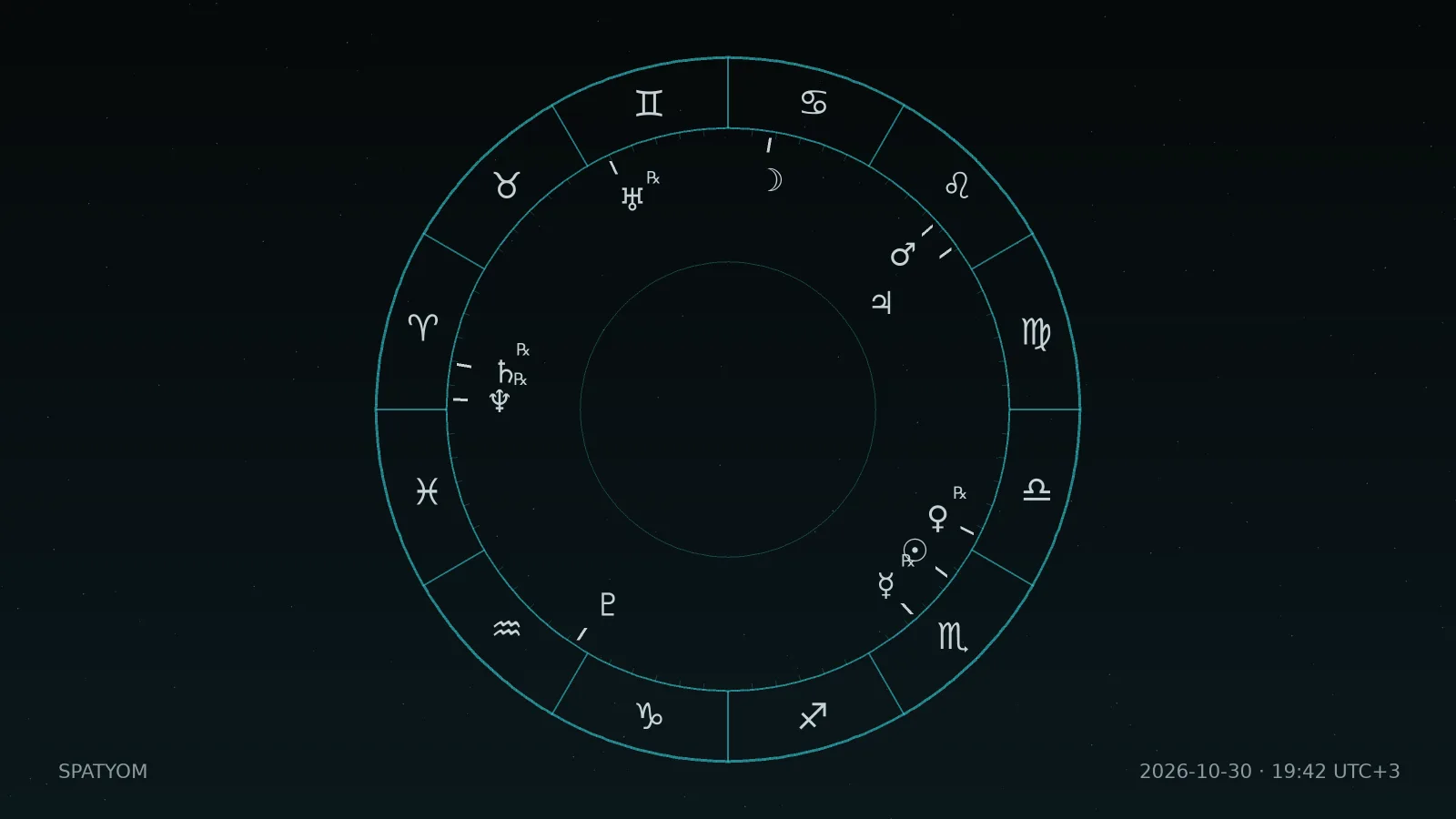
Boslough calculates that if the Tunguska object is part of a cluster and this cluster is in an 18:61 resonant orbit, it could return near Earth every 61 years. Based on the 1908 event, he points to the years 1969 and 2030. However, 2026 has a special significance: The same resonance creates a close approach not only in June 2030 but also four years earlier, around Halloween 2026. Boslough says, "If the Tunguska object had missed Earth in 1908, it could have returned in 2030. The 2026 Halloween date is important because the same resonance creates the June 2030 close approach four years earlier, in 2026." Of course, this is entirely hypothetical: The Tunguska object would need to be part of a cluster, and this cluster would need to have the same orbital elements as the hypothetical swarm. From an astrological perspective, the autumn of 2026 was eventful: Venus went retrograde in Scorpio on October 3, Pluto stationed direct in Aquarius on October 16, and a Full Moon occurred in Taurus on October 26. Such transits are associated in astrological tradition with transformation, reassessment, and unexpected events. However, scientifically, there is no causal link between meteor showers and astrological transits; only a symbolic parallel can be drawn here.
Scientific basis: Two major unproven assumptions
Boslough's 2026 warning rests on two main assumptions: First, that the Tunguska object is part of a cluster; second, that this cluster has the same orbital elements as the hypothetical Taurid swarm. Neither of these assumptions has been proven yet. Boslough says, "I will be the first to say that it is extremely speculative because of these two big 'ifs.' We don't know if either is true." He also notes that the Taurid resonant swarm hypothesis is testable and that we will learn definitively in 2032 whether it really exists. This is a beautiful example of the scientific method: A hypothesis is put forward, tested, and accepted or rejected based on its results. Astrology, however, is a different field; symbolic interpretations are not subjected to scientific testing. Therefore, when interpreting such an astronomical event astrologically, it is important to keep in mind the scientific uncertainty and the limits of astrology.
Taurid meteors and astrological symbolism
Astrology uses celestial movements as a symbolic language. Meteor showers are generally interpreted in astrology as sudden changes, unexpected events, and "messages" from the sky. The Taurid meteors peak each October–November, that is, during the period when the Sun is transiting Scorpio. Scorpio is associated in astrology with transformation, the revelation of the hidden, and deep changes. In 2026, the sky is busy during the days when the Taurid meteors are most active: Venus, which went retrograde in Scorpio on October 3, returned to Libra by retrograde motion on October 25. Mercury has been retrograde in Scorpio since October 24. Right after Halloween, on November 1 at 23:30 TRT, a Last Quarter will occur in Scorpio. This combination can be interpreted in astrological tradition as a re-questioning of material and spiritual values, deepening in relationships, and unexpected awareness. However, these interpretations are a symbolic reflection of astronomical events and carry no scientific claim. The meteor shower itself is a natural event caused by Earth's encounter with comet debris; its astrological meaning is entirely cultural and symbolic.
Planetary transits and the autumn of 2026
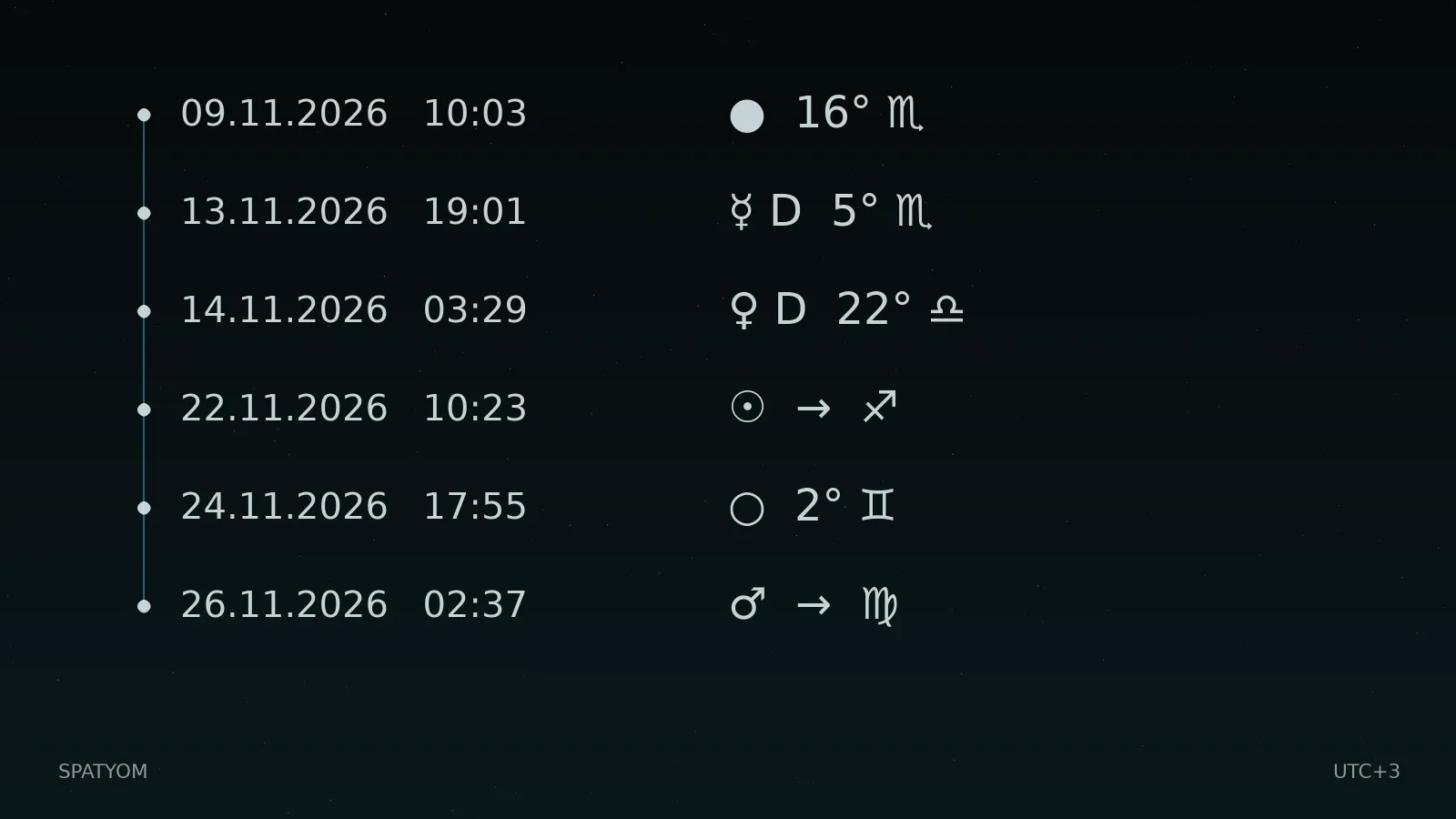
The autumn of 2026 was quite eventful astrologically. The Sun entered Libra on September 23, highlighting themes of balance and harmony. The Full Moon in Aries on September 26 emphasized issues related to beginnings and courage. Venus went retrograde in Scorpio on October 3; this period is interpreted as an inner questioning in relationships and values. Pluto stationed direct in Aquarius on October 16; this is associated with themes of collective transformation and restructuring in social structures. The Taurus Full Moon on October 26 brought issues of material security and stability to the fore. Currently, the Sun has been in Scorpio since October 23. Mercury has been retrograde in Scorpio since October 24, and Venus continues its retrograde in Libra. In the coming days, there is a Last Quarter in Scorpio (November 1, 23:30 TRT) and a New Moon in Scorpio (November 9, 10:03 TRT). Mercury will station direct on November 13, and Venus on November 14. The Taurid meteors are peaking right in this period. In astrology, meteor showers are generally symbolized as "sudden news from the sky"; however, it is not claimed that they have a direct effect on astrological charts. They are rather seen as a tool for awakening or drawing attention in the collective consciousness. In this article, it is important to clearly separate the astronomical event itself and the limits of astrological interpretation.
Conclusion: Between speculation and symbolism
In summary, the idea that the Taurid meteors could cause an airburst in 2026 is entirely speculative and rests on two major assumptions. Scientists point to 2032 to test this hypothesis. From an astrological perspective, such events can be associated with sudden changes and transformations on a symbolic level; however, astrology is not a predictive tool but an interpretive tradition. When and where celestial events occur can be calculated; interpretation is built upon this calculation. Therefore, being aware of both astronomical reality and astrological symbolism while observing the Taurid meteors can help us understand the sky more deeply. Remember, the sky is always a field of discovery, and we are part of this infinite universe.
Comments
No comments yet. Be the first.