 Spatyom

Fixed Star Mirfak: A Quiet Will at the 2nd Degree of Gemini
Mirfak is a bright star at the heart of the Alpha Persei Cluster in the Perseus constellation, positioned at the 2nd degree of Gemini. This article explores the star's astronomical identity, astrological tradition, and what it may signify when prominent in a chart.
There are points in the sky that pass unnoticed in your chart—until a planet lands exactly on them. Mirfak is precisely such a star. It shines in the middle of the Perseus constellation, at the heart of a young star cluster, and in astrological tradition corresponds to the early degrees of Gemini. It has an apparently calm, even modest brightness; yet classical texts, through the meanings they attribute to it, describe a serious will beneath this silence. In this article, we examine step by step what Mirfak is, where it stands in the sky, and which themes it might highlight when it becomes prominent in a birth chart.
The Astronomical Identity of Mirfak
Mirfak, also known as Alpha Persei, is a bright star in the Perseus constellation. With a spectral type of F5 Ib, this star has a yellow-white hue and is considered second magnitude in terms of visual brightness. It is not alone in the sky but lies at the center of a young open star cluster called the Alpha Persei Cluster. This cluster is a structure of relatively young stars that originated from the same star-forming region.
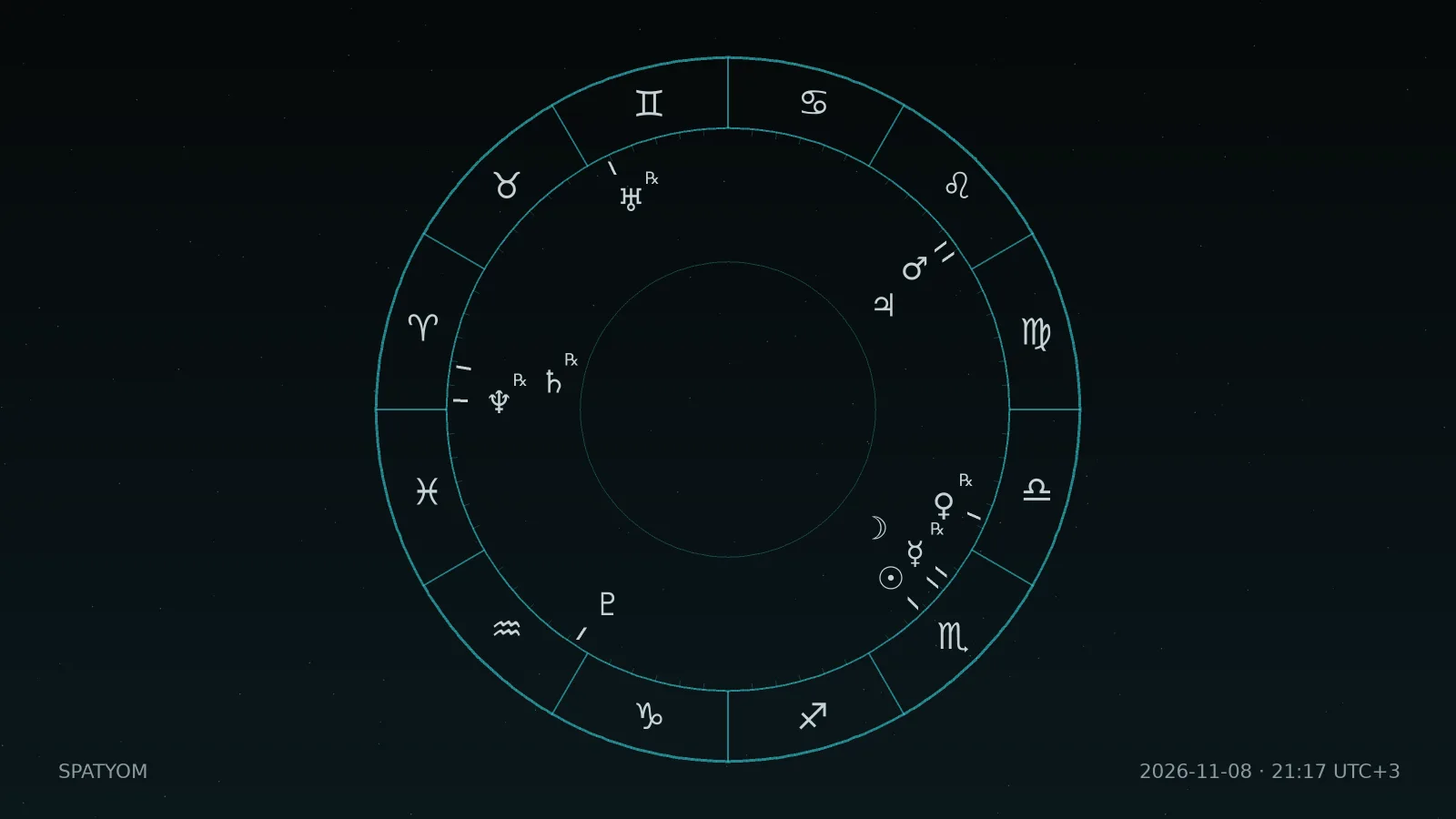
In astrological positioning, Mirfak is considered to be near the 2nd degree of Gemini and is defined as having an area of influence of about 2 degrees 20 minutes around it. This is a fairly wide but distinct range for a planet to be considered in "conjunction" with the star. The star's name comes from an Arabic expression and has been written in various forms in different languages throughout history; in some sources, it is referred to by a phrase meaning "the elbow of the Pleiades." In Chinese astronomy, it appears under a completely different name as part of the "Celestial Boat" asterism. This multi-layered naming also shows how the star has gained different meanings in different cultures.
The important point for astrology is this: Mirfak is not a "point" but a calculable position. Its place is known in ephemeris tables, and over the centuries its degree shifts slightly, and this shift is calculated in advance. So the interpretation based on Mirfak rests not on guesswork but on calculation. Keeping this distinction in mind is necessary to understand why fixed star studies are still taken seriously.
What Does Mirfak Represent in Traditional Astrology?
Classical sources generally classify Mirfak as a star of Mercury nature; its F spectral type is also associated with this planetary nature. This Mercury connection directly shapes the star's theme: mental sharpness, learning, trade, books, and dealing with ideas. When prominent on the Ascendant, it is associated with honor, intelligence, and a great desire to learn; at the Midheaven, it is linked to business activity and gains from intellectual matters. This confirms the star's "bright mind" theme from two different chart points.
However, tradition does not leave Mirfak merely as a positive symbol of the mind. Some texts define it with a Jupiter-Saturn nature, a high and luminous mental brilliance; interpretations of the F spectral class point to a serious, thoughtful, hardworking, adventurous yet equally reticent and demanding nature. The same sources also mention the possibility of a fall after rise, melancholy, and tensions brought by excessive ambition. This dual tone shows why the star should be interpreted with careful language: Mirfak is neither a pure blessing nor a sign of disaster.
The Perseus constellation itself also feeds this interpretation. In mythology, Perseus is told as a hero who completes a difficult task and saves his loved ones; but on his return journey, he inadvertently experiences great sorrow. The constellation is said to carry a Jupiter-Saturn character in traditional astrology, giving an intelligent and courageous nature, but also possibly a tendency to lie. Mirfak stands at the very center of this broad story; that is, the meaning of the star cannot be thought of independently from the meaning of the constellation it belongs to.
What Does It Signify When Prominent in the Chart?
The effect of a fixed star in the chart is read not on its own but depending on which planet it contacts. Mirfak is associated with a theme of literary and intellectual recognition in conjunction with the Sun; in contact with Venus, it is noted that artistic and aesthetic sensitivity may come to the fore. As an example of conjunction with Mars, the chart of Jeb Stuart is cited in traditional lists.
Conjunction with the Ascendant is one of the most cited positions of Mirfak. In this case, the star adds a kind of seriousness and desire to learn to the person's outward identity. The person may position themselves as a "knower" in their environment; collecting, organizing, and transmitting information may become their natural rhythm. However, interpretations of the F spectral class also include a warning: impatience, irritability, and excessive ambition in hard aspects can be seen as the shadow side of this theme. When interpreting, it is necessary to maintain this balance and offer awareness without using fear language.
Contact with the Midheaven brings the star together with career and public sphere. Traditional texts speak of a theme of gain through books, publications, and intellectual labor in this position. This shows Mirfak's connection with the "knowledge economy"; the transformation of ideas into a profession, the trace of this star can be sought in the chart of a teacher, writer, or researcher. Of course, this is not a promise but a description of a tendency; drawing definitive conclusions from a single star without the whole chart would not be correct.
Aspects That Require Careful Reading
In traditional literature, there are also some negative statements about the star cluster around Mirfak; especially warnings about harm to eyesight and blindness are among the foremost. Such expressions stem from the style of historical texts and should not be read today as literal predictions of physical outcomes. Astrology is an interpretive tradition; it should be remembered that a star does not determine "fate" but only describes an area of emphasis. No inference about health is made in this article; only what the tradition says is conveyed.
Similarly, the association of the Perseus constellation with events affecting large masses should be handled with careful language. Such connections describe the star's potential for "social scale"; however, presenting this as a harbinger of a specific event contradicts both the nature of astrology and responsible publishing. The healthiest approach when reading Mirfak is to see it as a "tone": mental intensity, seriousness, desire to learn, and at times an excessive ambition.
How this tone is experienced depends on which house the star is in and which planet it contacts, the condition of that planet, and the rest of the chart. For example, contact with a strong Mercury may bring out the star's most constructive face; a stressed Mars contact may increase impatience. Therefore, Mirfak is not a sign to be read alone but like a thread woven into the fabric of the chart.
How to Think About Mirfak in Daily Life?
Fixed stars often go unnoticed because they move slowly and do not produce great events on their own. However, when a planet passes through their degree, the star's theme becomes visible for a while. When it comes to Mirfak, this theme is usually about the mind: starting a learning process, finishing a piece of writing, taking an idea seriously, sharing information with others. During these periods, people may feel themselves directed toward a more "serious" mental effort; this is in harmony with the star's nature.
By the nature of Gemini, this theme is plural and mobile: dealing with multiple subjects, drawing from different sources, making connections. Mirfak adds a kind of weight to this plurality; it carries the potential to transform scattered curiosity into focused labor. The star's names meaning "hand" or "elbow" also support this idea: grasping, holding, and giving direction to something. So Mirfak is what the mind holds with its hand; what you hold depends on your chart.
Finally, moderation is the healthiest path in fixed star studies. Mirfak should not be absolutized as either a lucky star or a warning sign. The sky is calculable, but interpretation depends on context; as long as we do not confuse the two, fixed stars remain silent notes that add depth to the chart. Mirfak is exactly like that: a star that makes no noise, but when viewed from the right place, represents a serious will in the early degrees of Gemini.
Comments
No comments yet. Be the first.