 Spatyom

November Birthstone: Topaz or Citrine?
Those born in November have two birthstones: topaz and citrine. One is among the hardest silicates, the other the warm-colored member of the quartz family. We explore how the astrological birthstone tradition intersects with the zodiac and look at November's celestial calendar.
If you were born in November, two different stones are mentioned: topaz and citrine. Both are considered birthstones for the same month, yet their origins, hardness, and mineral structures are quite different. In this article, we introduce each stone with its own characteristics and connect them to November's place in the zodiac calendar.
Topaz: The Hardest Member of the Silicates
Topaz is chemically an aluminum silicate mineral; its structure contains fluorine and hydroxyl groups. These strong chemical bonds make it the hardest among silicate minerals, giving it a value of 8 on the Mohs hardness scale. Hardness is a direct measure of durability in the jewelry world: the harder a stone, the less its surface scratches and the longer it retains its original brilliance. This property makes topaz a preferred choice for daily-wear pieces such as necklaces, brooches, and bracelets.
Interestingly, pure topaz is colorless. Most of the blue, pink, red, brown, and yellow tones seen in showcases arise from trace element substitutions and structural defects within the crystal. Some of the red and pink tones come from chromium atoms in the crystal. Some colors are unstable and may fade over time; heat can also alter color. Colorless topaz can be turned blue by high-energy irradiation.
Geologically, topaz forms in fluorine-rich environments, a condition rarely found in nature. Crystals typically grow in the late stages of magma cooling when sufficient fluorine accumulates. Another formation pathway is through fluorine-rich hot hydrothermal solutions passing through cracks in cooled rocks.
Color, Value, and Famous Examples
The topaz spectrum ranges from pale blue to black; however, market value varies greatly by color. The rarest and most valuable tone is red. Imperial topaz, in sherry, orange-yellow, and reddish-brown tones, is considered the most sought-after variety and commands high prices. Pink stones are also valuable. Light blue and pale yellow topazes are more affordably priced but still visually impressive.
Topaz is generous in size: it is found in all scales from small crystals to massive pieces. A rough specimen from Brazil weighing approximately 270 kilograms is displayed at the American Museum of Natural History in New York. The American Golden Topaz, one of the world's largest cut topazes, is at the Smithsonian National Museum of Natural History in Washington; it weighs about 4.6 kilograms and is 18 centimeters long.
Brazil leads in topaz production; the Minas Gerais region is the most well-known source. Pakistan, Sri Lanka, Russia, and Australia are also among producing countries. In the United States, topaz finds have been reported in Utah, Texas, and California. Beyond jewelry, topaz has an industrial use: because it maintains its durability at high temperatures, it is used as a heat-resistant material in furnaces and stoves, and in molds for molten glass and metal.
Citrine: The Warm Tone of the Quartz Family
Citrine is the yellow-toned member of the quartz family. Its color ranges from pale yellow to reddish-orange and then to brown; occasionally yellow-green specimens appear. The coloring element is iron. Natural citrine is quite rare; therefore, most citrines encountered in jewelry are heat-treated smoky quartz or amethyst. Knowing this distinction is important for understanding whether a stone is natural or treated.
Citrine and yellow topaz can be confused visually, but they differ in hardness. Topaz is 8 on the Mohs scale, while citrine is 7. This one-point difference manifests as susceptibility to surface scratches in daily use. Other stones with similar yellow tones include golden beryl and tourmaline. When citrine combines with amethyst in the same crystal, a special stone called ametrine emerges; specimens with vivid yellow and purple, with the division running through the middle of the stone, are especially admired.
The name citrine comes from the Latin word citrina, meaning "yellow." Its use as an ornamental stone began around 300 BCE in Greece during the Hellenistic period. Because it is associated with abundance and prosperity, it is also called the "merchant's stone" or "money stone." Brazil also leads in citrine production; Madagascar, the USA, Argentina, Myanmar, Namibia, Russia, Scotland, and Spain are among other sources.
How the Birthstone Tradition Meets Astrology
The idea of birthstones is a tradition that has accumulated layer by layer over centuries, along with planetary and zodiac attributions. In the Middle Ages, figures engraved on stones were believed to carry power; a thirteenth-century source writes that a falcon figure on topaz brings the favor of rulers. In ancient times, topaz was believed to cool boiling water, make the wearer cheerful, and bring pleasant dreams.
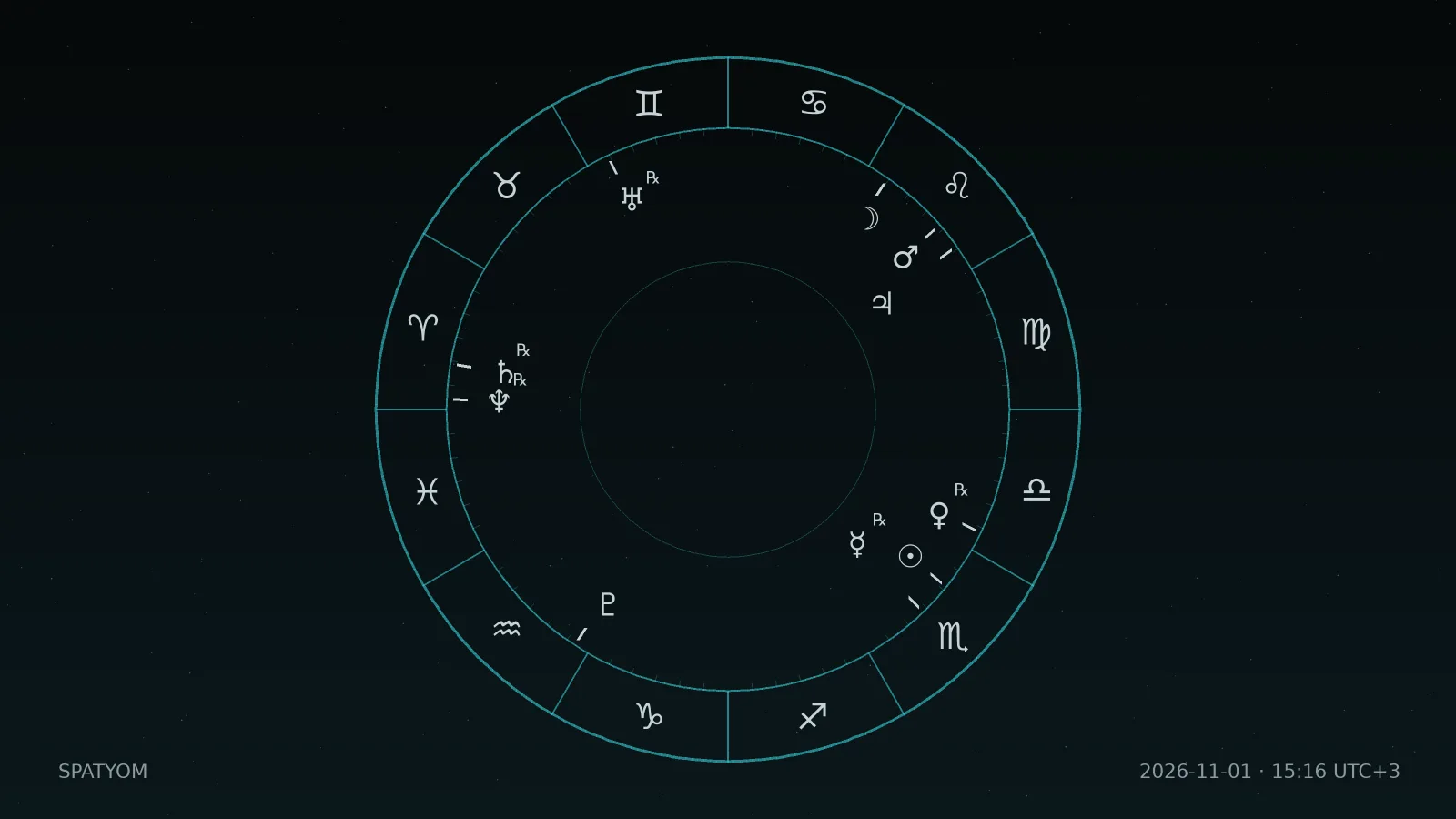
Today we read these accounts as historical folklore; the claim that stones affect health was part of the medical understanding of the era, not astrology. Today, the birthstone holds value as a personal reminder and an aesthetic choice. For most of November, the Sun is in Scorpio; in the last days of the month, the Sun enters Sagittarius. This transition is calculated as November 22, 2026, at 10:23.
November 2026 Celestial Calendar
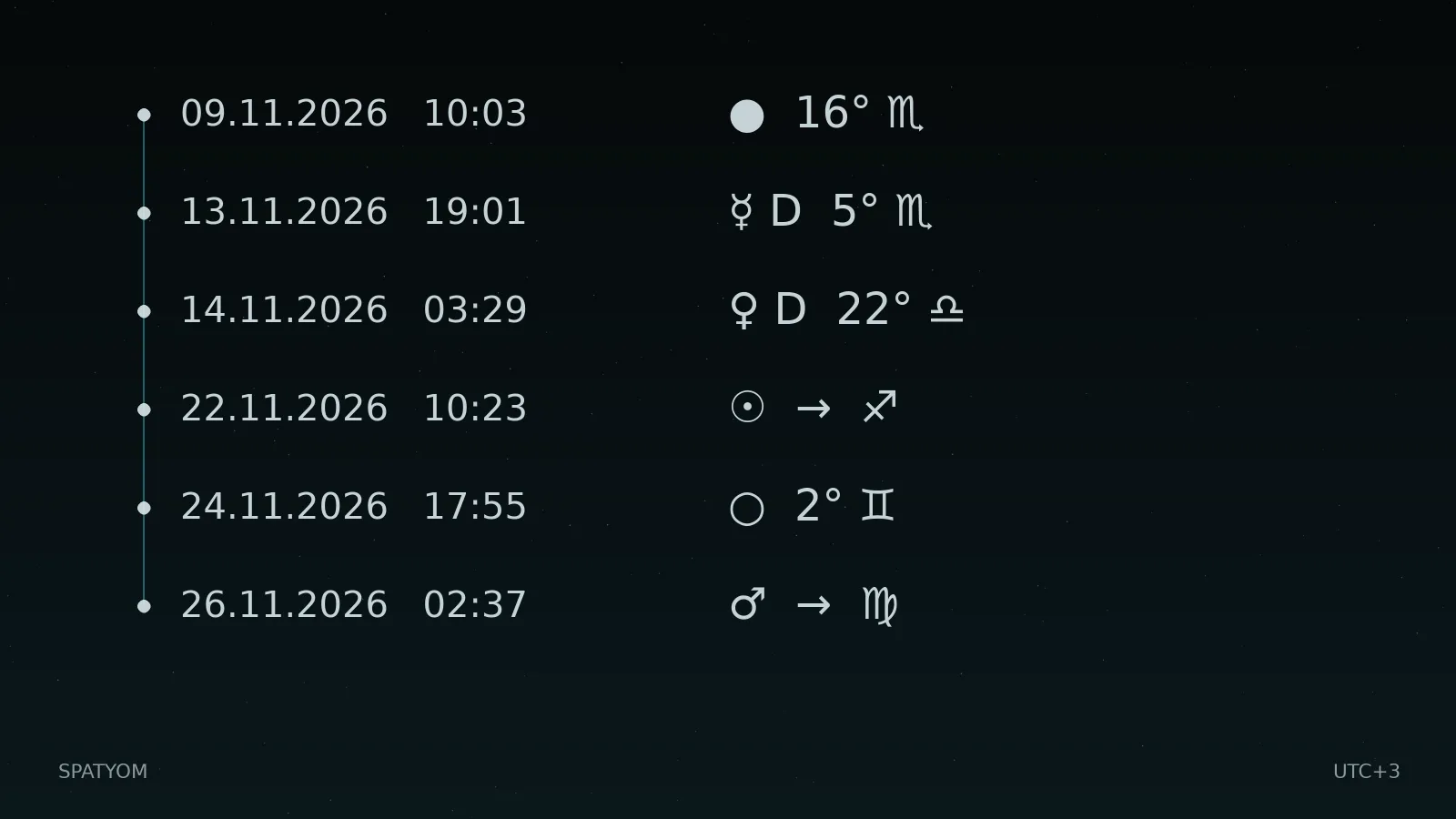
Connecting a birthstone article to a celestial event calendar might seem forced at first glance, but this is exactly where astrology's fundamental claim lies: the celestial event is calculated, and interpretation is built upon that calculation. In November 2026, the Moon phases and planetary movements draw a distinct rhythm. On November 9, 2026, at 10:03, a New Moon occurs in Scorpio. On November 13, 2026, at 19:01, Mercury stations direct from its retrograde in Scorpio. The next day, November 14, 2026, at 03:29, Venus in Libra completes its retrograde. On November 22, 2026, at 10:23, the Sun enters Sagittarius, and on November 24, 2026, at 17:55, there is a Full Moon in Gemini. On November 26, 2026, at 02:37, Mars enters Virgo.
This sequence indicates a tempo change that splits November in two: in the first half, Mercury and Venus complete their retrograde motions; in the second half, the Sun and Mars change signs. In astrology, retrograde periods are read not as disasters but as a review phase; emphasis is placed on revisiting communication and relationship themes. Stones like topaz and citrine also serve as symbolic reminders during such periods: to proceed without rushing, maintaining your own pace.
- November 9, 2026, 10:03 — New Moon in Scorpio
- November 13, 2026, 19:01 — Mercury stations direct (Scorpio)
- November 14, 2026, 03:29 — Venus stations direct (Libra)
- November 22, 2026, 10:23 — Sun enters Sagittarius
- November 24, 2026, 17:55 — Full Moon in Gemini
- November 26, 2026, 02:37 — Mars enters Virgo
Which Stone, Which Sign, Which Use
Thanks to its hardness, topaz can be comfortably used in pieces exposed to impact, such as rings and bracelets. Light blue tones give a cool and calm appearance; imperial topaz's sherry and orange tones leave a warmer, more striking impression. Citrine, being softer, is safer in pendants, earrings, or occasional rings. If daily intensive use is considered, one should account for citrine's greater susceptibility to scratching.
In astrological interpretation, stones do not promise definitive outcomes; they speak in a language of tendencies and reminders. For November-born individuals, the presence of two stones is actually an abundance of options: one is the warm and accessible face of the quartz family, the other the hardest member of the silicates. Whichever you choose, determining the stone's color and cut according to your own taste is the healthiest approach. The celestial calculation gives you the time; you construct the stone's meaning in your own context.
Comments
No comments yet. Be the first.