 Spatyom

52 Years Since Our First Message to the Universe: Arecibo's Silent Legacy
In 1974, the Arecibo telescope broadcast humanity's first deliberate signal into space. Fifty-two years later, we examine what this message conveyed, why it is still debated, and its place in the sky.
Humanity sent its first deliberate message into space on November 16, 1974. The Arecibo Observatory in Puerto Rico launched into space the most powerful radio signal ever intentionally broadcast up to that time. The goal was to attempt contact with a possible extraterrestrial civilization. Over the 52 years since, this signal has become the starting point of a debate we are still having today: should we announce our existence to the universe?
The architect of the message: Frank Drake and a simple design
The content of the signal was prepared by Frank Drake, a professor of astronomy at Cornell University, with contributions from a group of scientists that included Carl Sagan. What emerged was not a complex text but a plain pattern based on the binary number system. This 1,679-bit sequence was broadcast in just about three minutes. Compared with today's data speeds, it was almost snail-paced, yet the meaning it carried reached beyond the world.
Inside the message were the basic chemical building blocks of life, the double-helix structure of DNA, Earth's position within the Solar System, and even a human figure. Drake's approach rested on the assumption that a civilization could establish a common language through mathematics and physics. In this respect, the signal was less an information package than a signature left on the universe. The scientists hoped that a potential recipient could decode this pattern.
Arecibo's power and the choice of target
The reason the signal was so powerful was Arecibo's megawatt transmitter and its giant 305-meter dish. This antenna broadcast by focusing energy onto a very small region of the sky. According to the SETI Institute, this emission was equivalent to a 20-trillion-watt omnidirectional broadcast and could be detected almost anywhere in the galaxy with a receiver of comparable size. In other words, this detection was possible only if the antenna was pointed in that direction; the signal was sent to a single target in a narrow beam.
The target chosen was M13, the globular star cluster in the constellation Hercules. The reason for this choice was that the cluster is a large structure containing hundreds of thousands of stars and was in a suitable position in the sky that day. M13 is about 25,000 light-years from Earth. This distance means that it will take the signal roughly 25,000 years to reach the cluster. Today the signal is 52 light-years away from Earth; that is, it is still only at the very beginning of its journey.
A celebration or a warning?
The Arecibo signal provoked divided reactions in the scientific world as well as in the public. Some saw it as an exciting step that reminded us of the possibility that Earth is not alone in the universe. Others argued that if extraterrestrial civilizations exist, announcing our presence so openly could be risky.
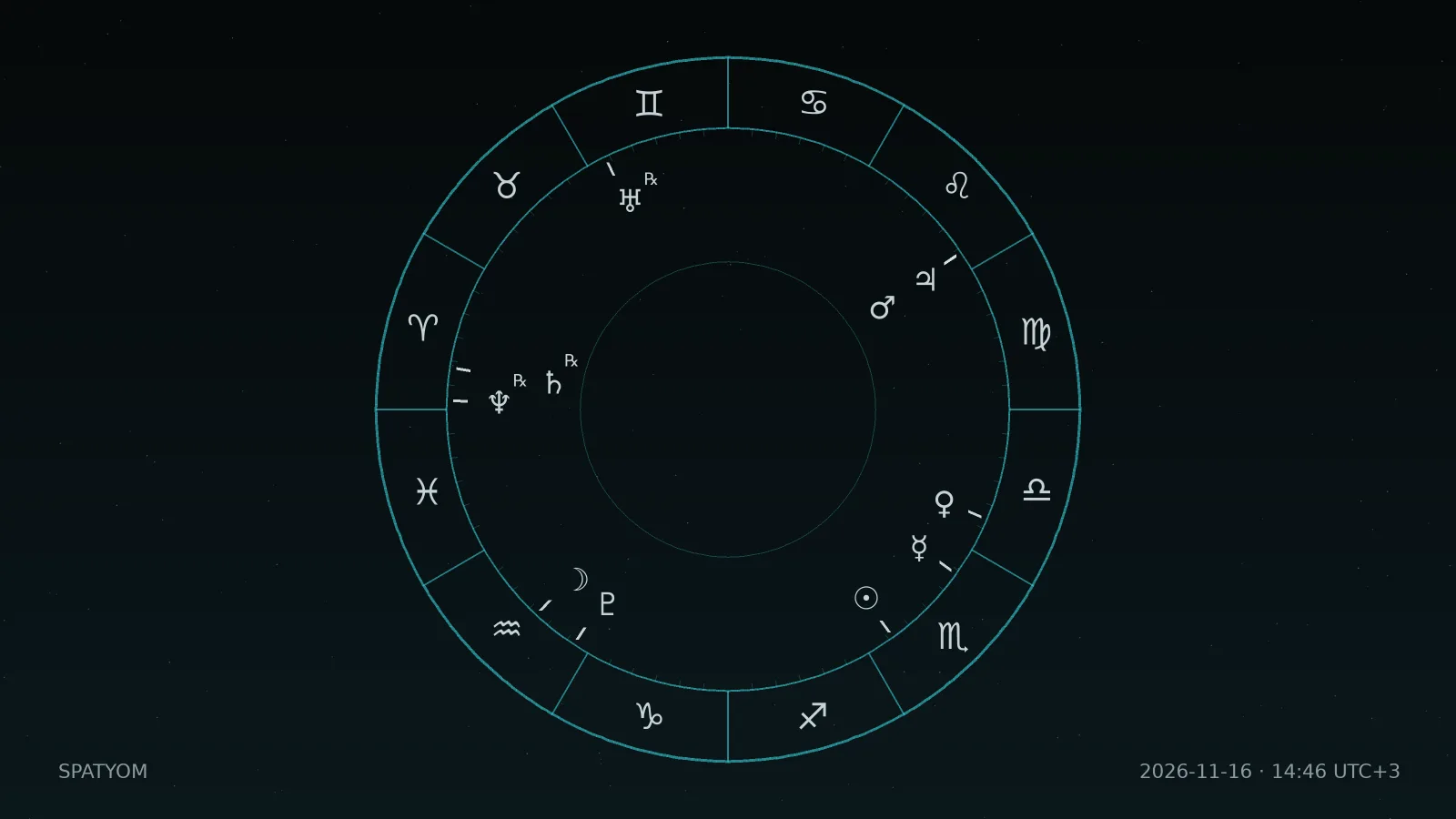
This debate is not an astrological matter, but it deeply affects our view of the sky. At the time the message was sent, Arecibo was one of the world's largest radio telescopes and was also used to listen for signals from space. In 2020, this era came to an end when the telescope's 900-ton receiver platform broke from its cables and fell into the dish. What remained was a message left on the universe and the questions it raised.
Looking at the same point in the sky today
Arecibo's message once set off toward the constellation Hercules. Today it is possible to observe M13 with an amateur telescope; the cluster is one of the brightest globular clusters in the northern hemisphere. Of course, it is not possible to see the signal itself. Even so, this story lets us think of the sky not only as a field of calculation but also as a stage for communication. Astrology interprets the meaning of positions in the sky, while astronomy measures the physical reality of that same sky. Though they speak different languages, they look at the same sky.
Arecibo's signal was one of the ways humanity questions its place in the universe. Fifty-two years later, this message is still waiting for an answer. Perhaps what matters most is not whether an answer comes, but that we keep asking the question. The sky, as an area that is both calculable and open to meaning, keeps humanity's oldest curiosity alive.
Comments
No comments yet. Be the first.