 Spatyom

Venus, Crescent Moon and Spica: Western Horizon on the Evening of September 13
On the evening of September 13, just after sunset, the western horizon presents Venus, a thin crescent Moon and Spica together. The trio creates a brief but impressive visual spectacle.
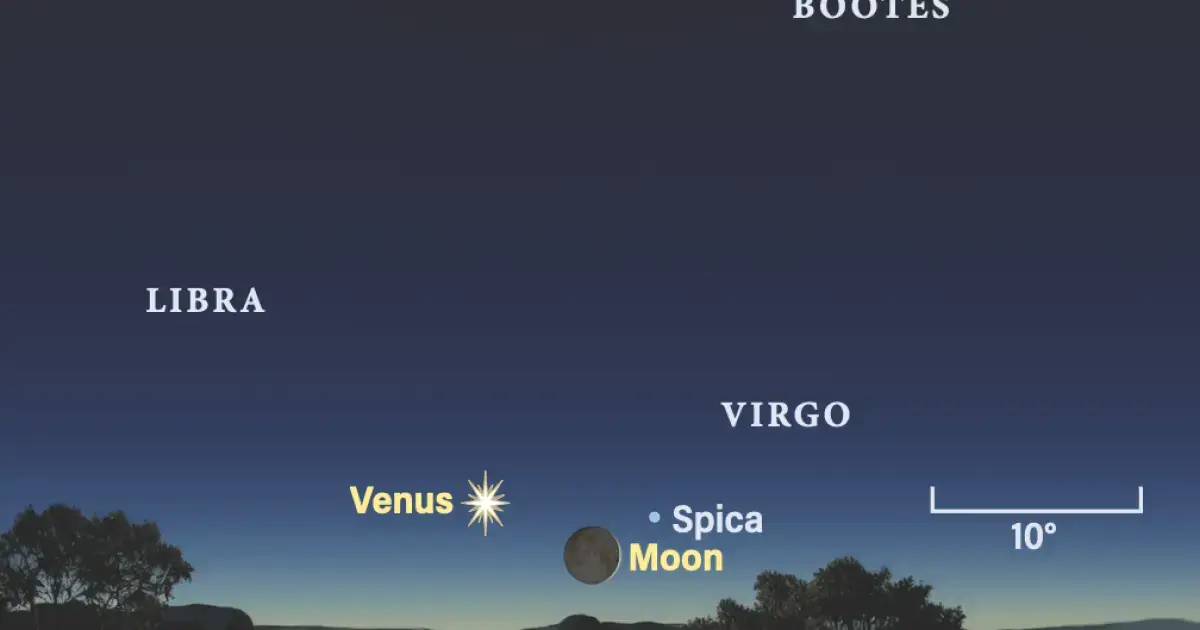
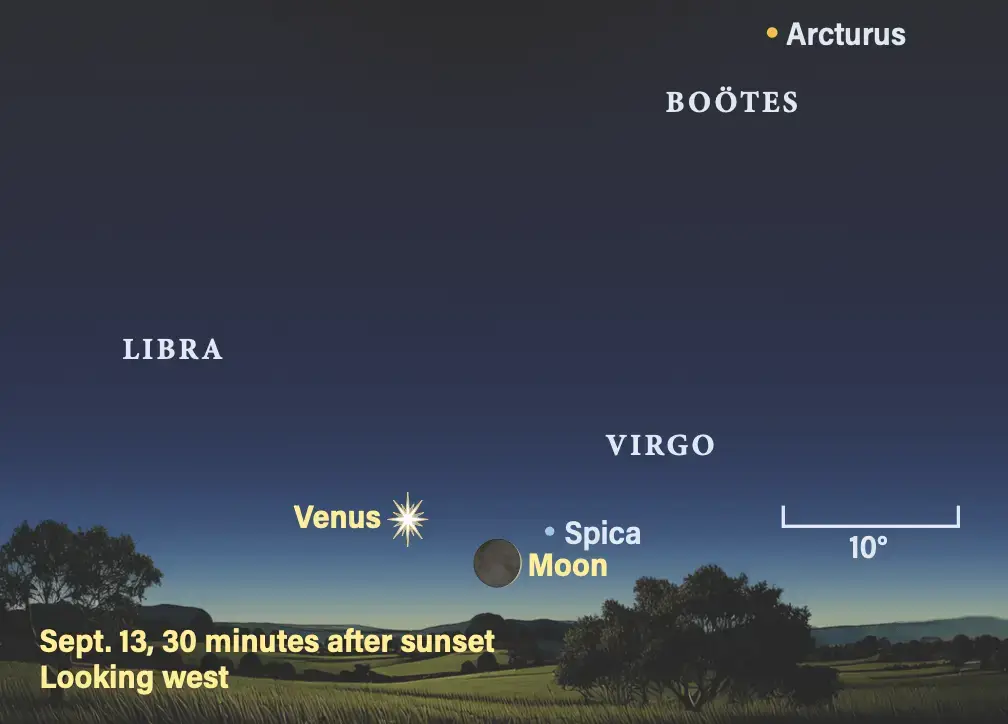
On the evening of September 13, just after the Sun sets, the western horizon offers sky enthusiasts a brief but unforgettable scene. Brilliant Venus, a thin crescent Moon and Spica, the brightest star of the constellation Virgo, appear on the horizon, forming a triangle. The trio becomes visible about twenty minutes after sunset, while twilight has just fallen. Having a high and flat horizon line is a great advantage for observation, because the objects are not very high above the horizon.
The Trio's Identity Cards: Venus, the Moon and Spica
Venus, with a magnitude of –4.8, is the most remarkable evening star in the sky. On this date, the planet approaches the phase where its illuminated surface appears largest; that is, when viewed through a telescope, it can be observed as a crescent shape but with a fairly large disk. Just to its lower right is the three-day-old crescent Moon; the Moon's illumination is around 10 percent, so it is a very thin crescent. To the upper right of the Moon shines Spica, with a magnitude of 1.0. Spica is a star located about 250 light-years from Earth and nearly 2,000 times brighter than the Sun. Together, the three line up on the western horizon, drawing a pleasant triangular pattern.
Observation Tips and Challenges
Venus is only 8 degrees above the western horizon after sunset. Therefore, an open horizon and timing are very important to catch it. The Moon is just to the lower right of Venus, in a nearly three-day-old crescent phase. Spica is positioned to the upper right of the Moon. If your observation site is high and your horizon line is flat, you can also try to see Mercury, with a magnitude of –0.6; however, Mercury will be only 2 degrees above the horizon twenty minutes after sunset and will sink below the horizon within about ten minutes. Catching Spica may not be so easy; just after sunset, it can be seen with the help of binoculars in the bright twilight. To notice it with the naked eye, you may need to wait for a slightly darker sky, but by then it will begin to disappear because it is close to the horizon.
Why Is This Alignment Special?
It is not always common for Venus, the Moon and Spica to meet in the same region. Venus, as an inner planet, moves quickly and frequently changes position. The Moon, on the other hand, progresses westward each evening. The coming together of this trio in a narrow area creates a short-lived conjunction in the sky. It is an excellent opportunity especially for astrophotographers to capture a wide-angle night scene. The thin crescent of the Moon, the brightness of Venus and the blue-white light of Spica together create an aesthetic composition. Moreover, such alignments, as examples of celestial mechanics observable in daily life, remind us of the dynamic structure of the sky.
Timing and Sky Conditions
On the evening of September 13, sunset will occur at 19:12 (local time for 40° north latitude and 90° west longitude). Twenty minutes after the Sun dips below the horizon, Venus will be 8 degrees above the western horizon. The Moon will have risen at 9:24 and will have taken its place in the sky during sunset. The Moon will set at 20:10. Therefore, the observation window is quite short: the trio must be caught within about half an hour after sunset. The Moon's illumination is around 10 percent, so the thinness of the crescent makes it look even more elegant. As long as the sky conditions are clear, this meeting can be easily watched with the naked eye. To see Spica, binoculars may be needed, because although its brightness is 1.0 magnitude, it can be difficult to notice in twilight.
In summary, on the evening of September 13, the western horizon brings together the brightness of Venus, the thin crescent of the Moon and the distant light of Spica. This short-lived conjunction is both a visual feast for sky watchers and a beautiful example of the calculable order of celestial events. When observing, it is enough to adjust the timing well and make sure the horizon is clear.
Comments
No comments yet. Be the first.